
THANK YOU FOR SUBSCRIBING
× 
Startup City Weekly Brief
Be first to read the latest tech news, Industry Leader's Insights, and CIO interviews of medium and large enterprises exclusively from Startup City
Startup City: Specials Magazine
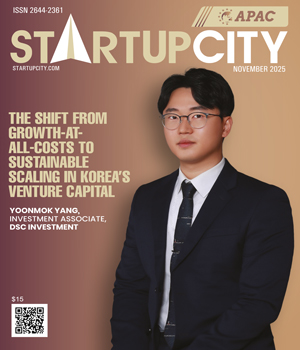
DSC Investment
The Shift from Growth-At-All-costs to Sustainable Scaling in Korea's Venture Capital
Yoonmok Yang is a venture capitalist and Investment Associate at DSC Investment, with prior experience at Bain & Company and Hyundai Motor Company. He specializes in AI, venture funding and strategic growth. A KAIST graduate, he actively invests in startups, focusing on emerging technologies and global market expansion. Through this article, Yang emphasizes the resilience of Korea’s venture capital and startup ecosystem, highlighting the role of government policy funds in sustaining investment and underscoring the shift towards scalable, revenue-generating business models as the key to long-term success. The Korean venture capital and startup ecosystem has displayed a relatively resilient trajectory, even as global capital markets face persistent headwinds. A key driver of this resilience is a series of government-led policy funds, which have expanded significantly and compensated for the reduction in private capital contributions. Official figures indicate that venture investment size in Korea grew by around 9.5 percent from the previous year, reaching almost 9 billion USD, contrasting sharply with stagnant or marginally negative growth in other major markets. While this uptick underscores the country’s commitment to fostering entrepreneurship, it also reflects the Korean government’s determination to bolster early-stage and growth-stage financing through a more robust policy framework.
Robotics
Edge-based AIoT technology is shaping the future of connected environments by enabling local data processing, streamlining decision-making and enhancing user control. MySmaX is at the forefront of this transformation with its service-centric AIoT platform, JOI, and a JOI-installed edge device, called JOI Hub. The solution securely manages communications and interactions between various devices, transforming complex device-specific management into service-centric automation. “Building the JOI AIoT platform around edge computing has enabled us to create a truly secure, reliable and user-centered smart platform,” says Soonhoi Ha, CEO. MySmaX primarily caters to smart commercial and industrial spaces, high-trust environments and homeowners. Factories, farms, warehouses and offices experience scalable automation that streamlines operations, optimizes resource use and reduces downtime. In high-trust environments where critical infrastructure is held to stringent data privacy and reliability requirements, JOI ensures that sensitive information remains local and devices operate securely. It equips residential properties with intuitive automation across lighting, climate, security and robotic services, without technical complexity. JOI stands apart by delivering absolute convenience, built-in security and future-ready flexibility, all within one intelligent platform. Users simply need to describe what they need, and it seamlessly coordinates devices without the hassle of multiple apps or compatibility issues. Operating at the edge, it ensures privacy and resilience even if one device is compromised. When clients scale, it adapts dynamically and integrates any device or service into the network. These capabilities make it not just smart but intuitively designed for real-world impact. Its technology reduces the risk of interception during data transmission. Devices communicate exclusively through the secure middleware, which authenticates commands and blocks unauthorized access, giving users complete control over their environment. They can define automation scenarios, select compatible devices and decide what data leaves their premises. Privacy and control are pre-integrated. JOI routes all device communications through a local server, enabling real-time behavioral monitoring. Using AI-driven anomaly detection, it analyzes device activity against established behavioral baselines. Any suspicious activity, like conflicting signals or abnormal patterns, is instantly identified, isolated and reported to the user, preventing lateral spread and preserving system integrity. .

Japanese Biotech Startups

International trade has always been a grand stage where nations exchange goods, ideas, culture, and opportunity. However, behind this spectacle lies a complicated backstage. Exporters chase customs officers with stacks of forms. Importers watch anxiously as documents crawl through email threads. Banks, insurers, and logistics companies juggle phone calls and spreadsheets, often struggling to sync. The system functions with difficulty, consuming significant time and resources. That’s where TradeWaltz has emerged as a model for how public–private partnerships (PPPs) can transform global trade. Established in 2020 through a joint initiative of 18 of Japan’s leading corporations, including NTT Data Corporation, Toyota Tsusho Corporation, Mitsubishi Corporation, Sumitomo Corporation, and MUFG Bank, Ltd., the company represents PPP backed by the Ministry of Economy, Trade and Industry (METI). “Our goal is to build Japan’s national digital infrastructure for trade and extend that framework across borders through secure, standardized data exchange,” says Takahiro Sato, president and CEO. Building Japan’s Trade DX Infrastructure To achieve this, TradeWaltz provides a blockchain-powered SaaS platform that connects and allows all participants to share information with required parties instantly on a single, trusted network. This eliminates the dependence on emails, faxes, and redundant document entries, allowing data to flow instantly and securely between stakeholders. TradeWaltz’s approach: Standardization → Digitization → Visualization → Streamlining → Efficiency has already set the de facto standard for trade digitalization in Japan. Working with FUJIFILM Logistics and Hankyu Hanshin Express, TradeWaltz reduced process time by 47 percent through automation. Similarly, for Japanese exporters trading with Indonesia, the platform enables direct digital submission of shipping documents and customs data into Indonesia’s system, replacing paper-based processes with real-time, cross-border data flow..
Korean Startups
In the webtoon industry, renowned for its rigorous demands and tight deadlines, Cream emerges as a trailblazer. The pioneering startup is making waves by merging the virtual and tangible worlds with its flagship AI-assistant artist, AiD. This AI-driven tool is designed to help webtoon creators achieve consistency in their characters, setting a new standard in storytelling. Founded by CEO Ji-seong Kim, a luminary with roots in IT Convergence Engineering from the prestigious Pohang University of Science and Technology, Cream leverages AI to address one of the most complex challenges for webtoon artists—maintaining consistency across characters and scenes. It all started with a simple yet ambitious goal—to simplify the creative process for artists, enabling them to focus on storytelling and production. Kim embarked on a journey to leverage AI not just as a tool but as an assistant for webtoon creators. This journey culminated in the launch of AiD—an AI-driven assistant that offers personalized lining, coloring, and shading services that artist can access via a user-friendly web interface. Creators often find themselves bogged down by the intricacies of line art and coloring, which, although necessary, can stifle creativity and extend production timelines. AiD addresses these challenges head-on, allowing them to focus more on storytelling and less on labor-intensive art production. By submitting just 7 images of a character, creators can use AiD to generate line drawings and colored panels that remain true to their original vision, all while reducing their time and effort.

Japanese Biotech Startups

Optimizing The CFO Stack Against Inflation
Ivan Ong, Principal, AFG Partners
Japanese Biotech Startups

Fueling Cutting-Edge Technology Companies through Investment and Collaboration
Jie Teng, Co-Founder, Venturous Group
Japanese Biotech Startups

A New Era of AI-Driven Seafaring
Niklas Holck, Founder & CEO, Tradeworks.vc and Shail Barthwal, Founder & CEO, Nexus Ocean AI
BioTech Startups

Evolving the Digital Wave in the Start-Up Space
Jeremy Loh, Co-founder and Managing Partner, Genesis Alternative Ventures
BioTech Startups

Why Venture Capitalists Always Negotiate Valuations Even When They Seem Reasonable
Johnny Yu, Managing Director, Mosaic Venture Lab

IN MY OPINION
Japanese Biotech Startups
Shaping The Future of Innovation and Venture Capital
John Lim, Partner, Meet Ventures

LAST WORD
Japanese Biotech Startups
The Coming Third Wave of Digital Retail
Jan Gasparic, Co-founder, CEO, Fairmart
IN FOCUS

Asia-Pacific's Automation Leap: RaaS Empowers the Startup Frontier
Robotics-as-a-Service (RaaS) democratizes automation by reducing costs and barriers for startups, especially in the APAC region, enabling innovation through cloud robotics and modular platforms.

Tracking Japan's Five-Year Startup Expansion Plan
Japan's ambitious Five-Year Plan aims to transform its economy by fostering startups, increasing investments, and creating a supportive innovation ecosystem to stimulate growth and global competition.
EDITORIAL
Advancing the Next Chapter of Smart Technology
The startup landscape in Asia-Pacific is evolving rapidly, driven by advances in AI, IoT, and robotics intelligence. In Japan, a growing number of early-stage companies are pushing the boundaries of technology across sectors such as deep tech, healthcare, mobility, and industrial automation. Programs like J-Startup have accelerated the growth of ventures that blend advanced engineering with global ambitions. Many companies are leading the way by integrating artificial intelligence with connected devices to create smarter manufacturing processes and innovative solutions for daily life. New startups are exploring edge computing and nature-inspired models to deliver efficient, intelligent systems that go beyond traditional robotics.
Across the broader APAC region, AIoT and robotics are transforming industries including logistics, elder care, hospitality, and manufacturing. Machines are becoming adaptive, networked, and capable of learning and predicting in real time. Demographic shifts, labor shortages, and infrastructure investments are creating ideal conditions for these innovations to thrive. Investors and businesses are closely watching these developments as many of these ventures prepare to scale internationally, signaling a new era of smart technology and innovation in the AsiaPacific region.
This edition of Startup City APAC brings you the latest insights into these transformative technologies, showcasing the companies and innovations that are leading the charge in AIoT and robotics across Asia-Pacific. From Japan’s cutting-edge startups to the broader regional shifts, we explore the new frontiers in smart technology and the growing potential for international expansion.
It features John Lim, General Partner at Meet Ventures, and Jan Gasparic, Co-founder and CEO of Fairmart, who offer their expert insights on the dynamic startup ecosystem and the critical trends that are redefining the future of AI, IoT, and robotics.
We hope this edition will deepen your understanding of the rapidly evolving landscape and inspire actionable strategies, whether you're an entrepreneur, investor, or innovator looking to make your mark in the AI, IoT, and robotics sectors across Asia-Pacific.
