THANK YOU FOR SUBSCRIBING
× 
Startup City Weekly Brief
Be first to read the latest tech news, Industry Leader's Insights, and CIO interviews of medium and large enterprises exclusively from Startup City
Startup City


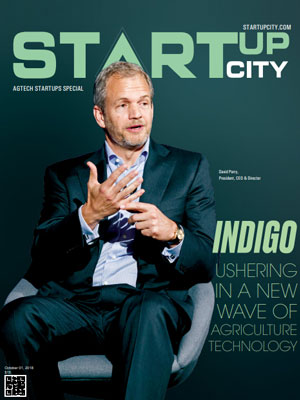
Indigo
Ushering in a New Wave of Agriculture Technology
 David Perry, President, CEO & Director
"Inspired by insights from the human microbiome, Indigo started with the hypothesis that microbes living inside the plant (endosymbionts) are vital to their health"
The secret actually lies within the seeds that Bush sows. Each of those wheat seeds is specially treated using advanced microbial technology to improve crop performance despite different environment stresses—an avant-garde solution brought by a Massachusetts-based AgTech company, Indigo. The motto of Indigo is to “harness nature and help farmers sustainably feed the planet.” The indigo-colored flags planted in the field (representing the name of the company), are used as markings to demarcate Indigo-treated wheat seeds from other standard seeds that are readily available in the market.
Off the Farm and Into the Laboratory
At its core, Indigo desires to create a world where farming is an economically desirable and accessible profession. David Perry, president, CEO and director of Indigo says, “AgTech has always been a frequently overlooked subject. While technology has led us to develop gigabit speeds for internet service, we still plant and harvest vegetables like the way we did centuries ago. Therefore, it is high time agriculture technology gets an overhaul.” Ever since Indigo was established in 2013, fulfilling this vision has been the ultimate goal of the company.
Inspired by insights from the human microbiome, Indigo started with the hypothesis that microbes living inside the plant (endosymbionts) are vital to their health.
Indigo’s seed treatment technology depends on a symbiotic relationship with plant microbes
Today, using sophisticated genome sequencing and computational bioinformatics, Indigo has assembled an enormous database of genomic information from these plant microbes. “We apply algorithms and machine learning to this database and predict which microbes are most beneficial to the plant’s health. Following this, we use those specially selected microbes to coat the seeds,” explains Perry. The microbes grow as their host (the plant) grows and the resulting seed treatment complements the plant’s natural processes to improve its health across each phase of life while boosting crop yields. Indigo’s seed treatment technology depends on a symbiotic relationship with plant microbes. “We give them a home and an environment in which they can thrive, and in return some of them aid in fighting off environmental stressors, and optimize the crop’s growth behavior in some way,” mentions Perry.
He further elucidates that the plant microbes can be utilized to impact all sorts of common crop stressors, such as water stress, salinity, nutrient deficiency, and pest and disease susceptibility. Indigo decided to start with water stress because that is where they witnessed the fewest alternative products available to address the problem. Indigo’s current portfolio of specially treated seeds includes cotton, wheat, corn, soybeans, and rice. Indigo’s AgTech experts are contacted by farmers and agro-based industries across the U.S. to help them throughout their growing season, providing treated seed and data-based agronomic advice.
Building the World’s Largest Agricultural Lab
While farms are great places to run experiments, they are also incredibly challenging places to draw reliable conclusions. Due to variability across soil type, terrain, water, nutrients, pests, and environmental stresses, the complexities can be overwhelming— even within a single field. What is even more challenging is that there is no gold standard by which people can evaluate new technologies in agriculture. Agricultural companies constantly release their own data, which is neither standardized, nor vetted by agriculture experts or farmers, leaving growers to decide if they would want to incorporate the new knowledge into their fields. Many a times, this information comes from experiments that are done in highly uniform conditions, known as small-plot field trials, and the results acquired from such tryouts may not have relevance in the real farmer fields. These settings are largely responsible for slowing down the pace of innovation in the agriculture domain. This is where Indigo Research Partners—an innovative platform launched by Indigo Ag that enables collaboration among 50 leading growers and agronomic experts to evaluate agricultural technologies— has been able to strike a difference in the agricultural landscape.
“We are striving to create the new gold standard for agricultural R&D,” states Perry. Indigo Research Partners facilitates an entirely new method of agricultural research by eliminating the “one size fits all” approach associated with traditional field trials. The platform is designed to generate data relevant to a specific farm or field and lead to actionable insights for growers. “We are using sensors, weather stations, soil mapping technologies, drones, and satellites to sub-divide farms into thousands of distinct experiments and evaluate the performance of new seeds, agronomic practices, and farming equipment across real-world conditions,” informs Perry. The breadth and depth of these insights shall prepare growers to manage any number of environmental and field conditions, from cold and wet stress to heat and water scarcity. “Ultimately, Indigo Research Partners will serve as an open source data platform for all growers, delivering insights that can improve the profitability and sustainability of their farms,” remarks Perry.
Planting the Seeds: Creating New Value Zones
Despite the efficacy of this unique microbial treatment approach and the fact that Indigo has found an ecological solution that can be implemented at scale, the company still faces challenges in convincing farmers to adopt their technology. To address this, Indigo goes one step further and partners with buyers of farm products as an incentive for farmers to use Indigo’s seed treatment technology. Taking an instance of one such supply agreement, Perry talks about Grain Craft, one of the largest flour millers in the U.S. Indigo has agreed to supply at least one million bushels of wheat (meeting certain specifications) for the upcoming crop year. In order to achieve this, Indigo has already contracted with farmers to aid them in growing superior quality wheat and provide the growers a premium price for the harvest. “This is a very unusual agreement for an AgTech company, and a critical example of the confidence the agro-based industry has in our products,” remarks Perry.
The Fourth Agricultural Revolution in the Making
Indigo believes that success follows when one makes the right choices. Therefore, Indigo incessantly works alongside farmers to help them make the choices that will stretch and sharpen their ambition. “We want to help farmers run decisive experiments on hundreds of innovations each year,” envisions Perry. Thus, in addition to Indigo’s microbiome and data solutions, the company is also evaluating technologies of over a hundred startups with the goal of getting solutions that are best poised to improve productivity and sustainability of Indigo customers. Perry believes that these technologies, whether digital, microbial, or mechanical, represent the cusp of a new beginning in agriculture. The last agricultural revolution was built on the science of synthetic fertilizers and crop chemicals, with the philosophy of treating every acre the same. “We believe that the next agricultural rising will be built by farmers, innovators, and consumers, working together and treating every square foot of a field as unique,” concludes Perry.